Intelligence on the panel — not in the cloud
Aurora IQ puts an inference core in every cabinet and a control surface your client will actually open — live cabinet health, picture, routing and scheduling on one 10″ touch panel.
Processor software was built for commissioning, not for Tuesday
Your client's AV team inherits a tool designed for the person who mapped the wall. Aurora IQ sits in front of it and exposes only what the room needs.
Processor software assumes you mapped the wall yourself. Room staff avoid it, so nothing gets adjusted.
By the time someone reports a dark corner, the lecture is over and the evidence is gone.
No thermal history, no firmware inventory, no idea which card dropped frames last week.
Seven screens, one mental model
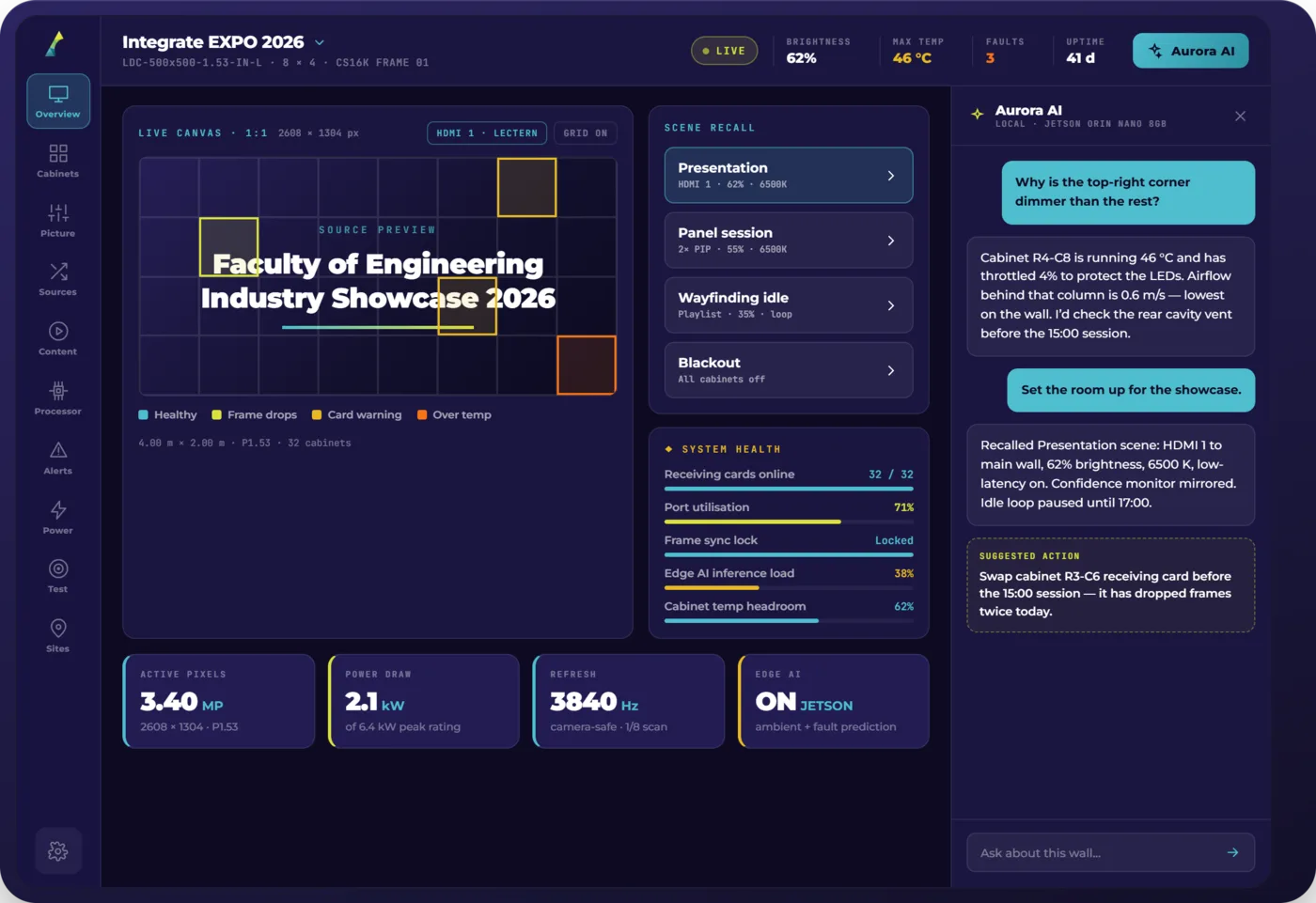
Every screen keeps the same header: wall identity, live brightness, hottest cabinet, open faults. Nobody gets lost mid-session.
Operators see exactly what the wall is showing, with every cabinet fault drawn over the live source instead of buried in a separate map.
- Scene recall puts the room in a known state in one tap
- Header carries brightness, hottest cabinet and open faults
- Health bars for cards, ports, sync and thermal headroom
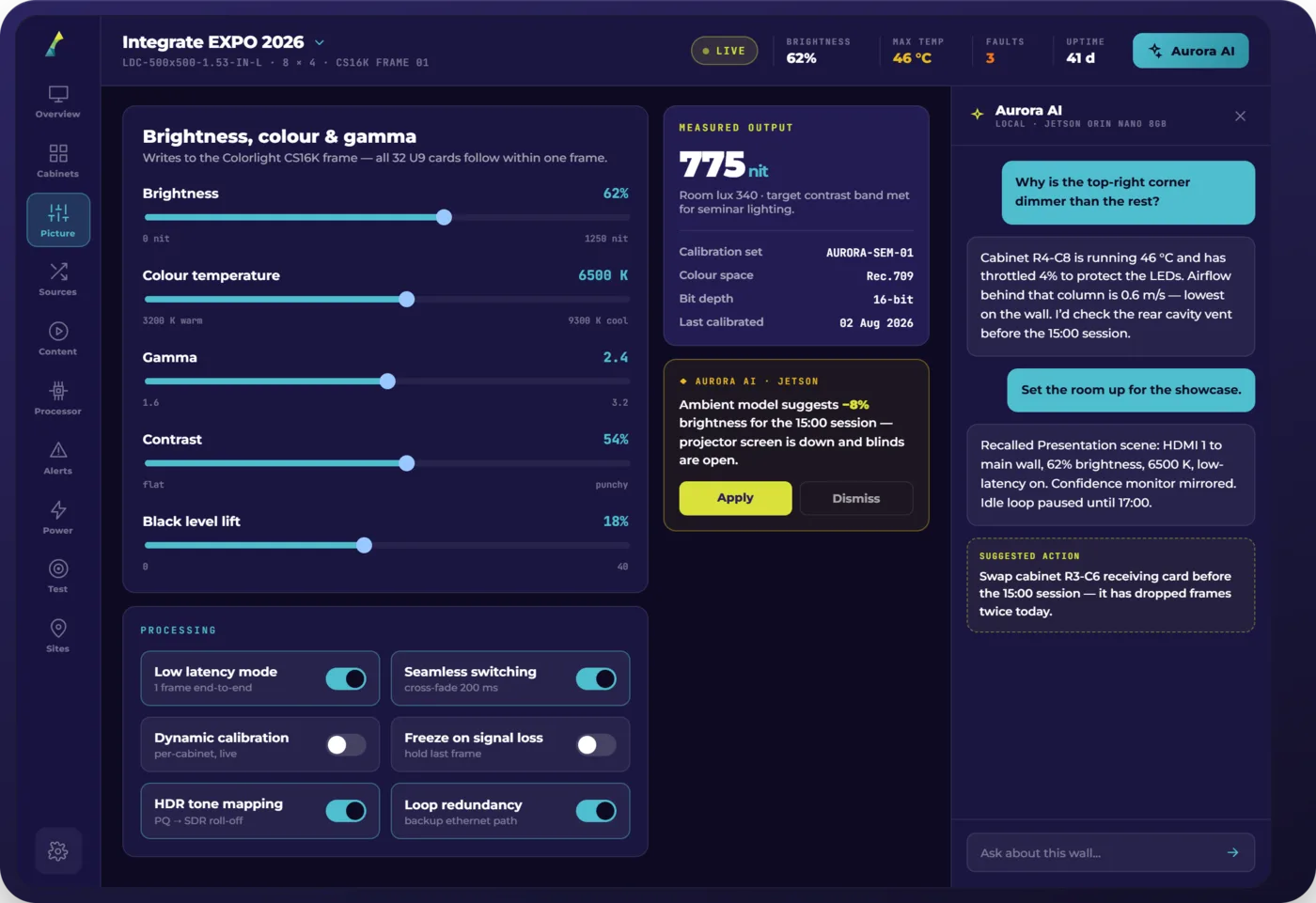
Sliders write straight to the processor and all receiving cards follow within a frame. Measured output in nits sits beside the control.
- Rec.709 calibration sets with 16-bit processing
- Low latency, seamless switching and HDR roll-off as toggles
- Edge AI proposes a setting; a human applies it
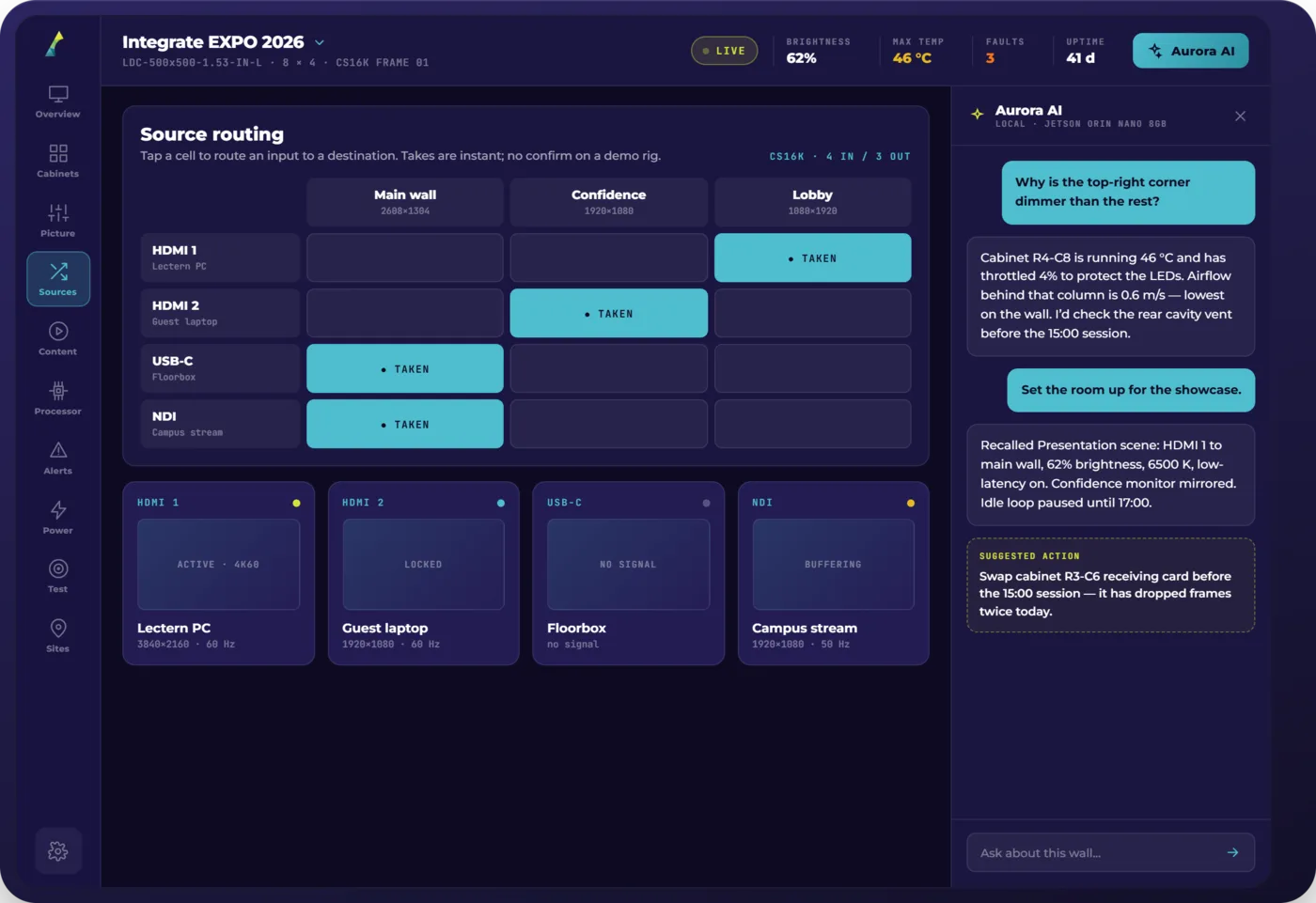
A tappable matrix across lectern, guest laptop, floorbox and campus stream — with lock state and format on every input tile.
- Seamless 200 ms cross-fade held in the frame
- Dead cables visible before the presenter finds them
- Main wall, confidence monitor and foyer totem in one grid
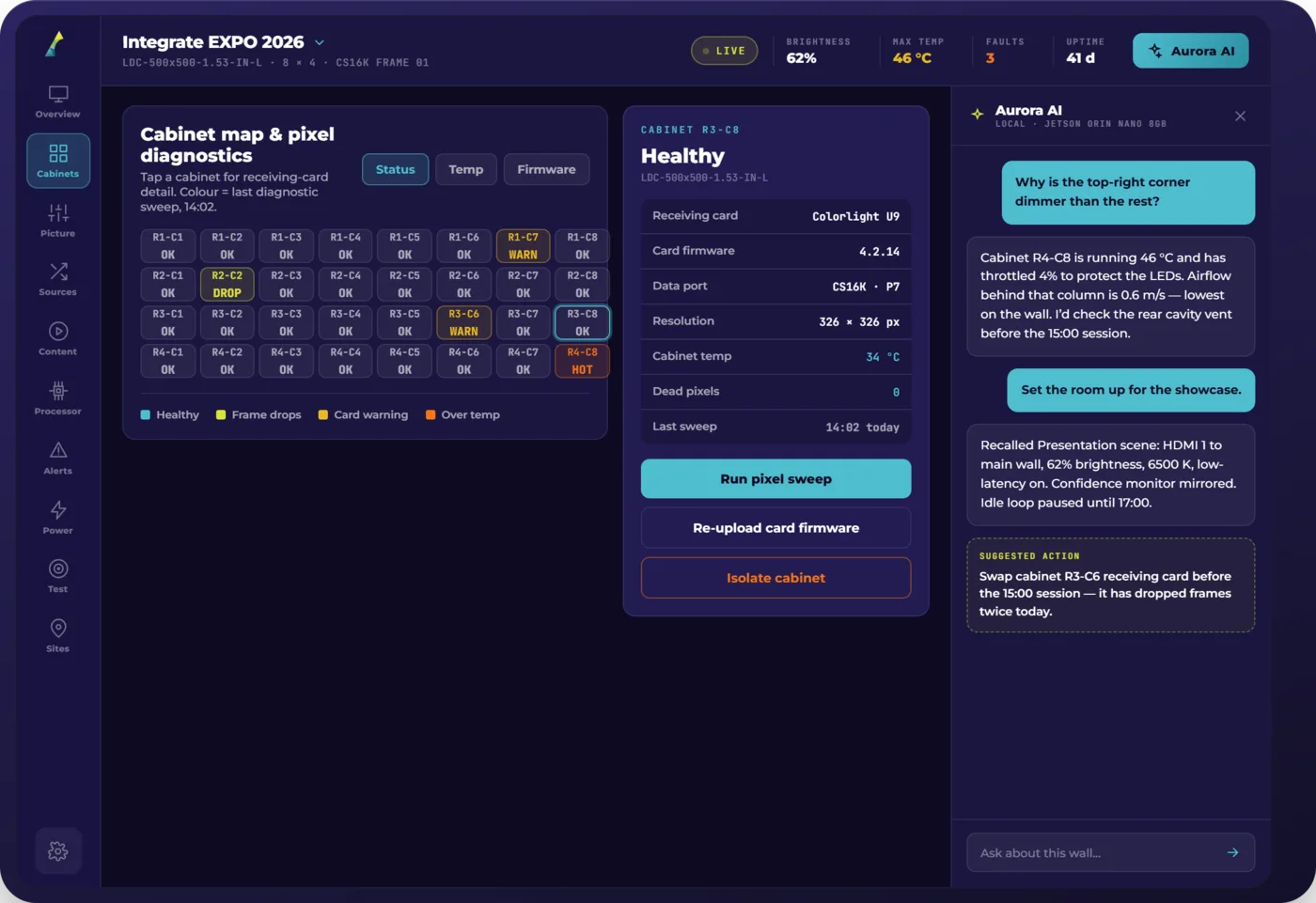
Tap any cabinet for firmware, data port, resolution, dead pixels and last sweep. Switch the whole map between status, temperature and firmware.
- Run a pixel sweep or reflash a card from the panel
- Isolate a bad cabinet and keep presenting
- Fleet firmware drift flagged automatically
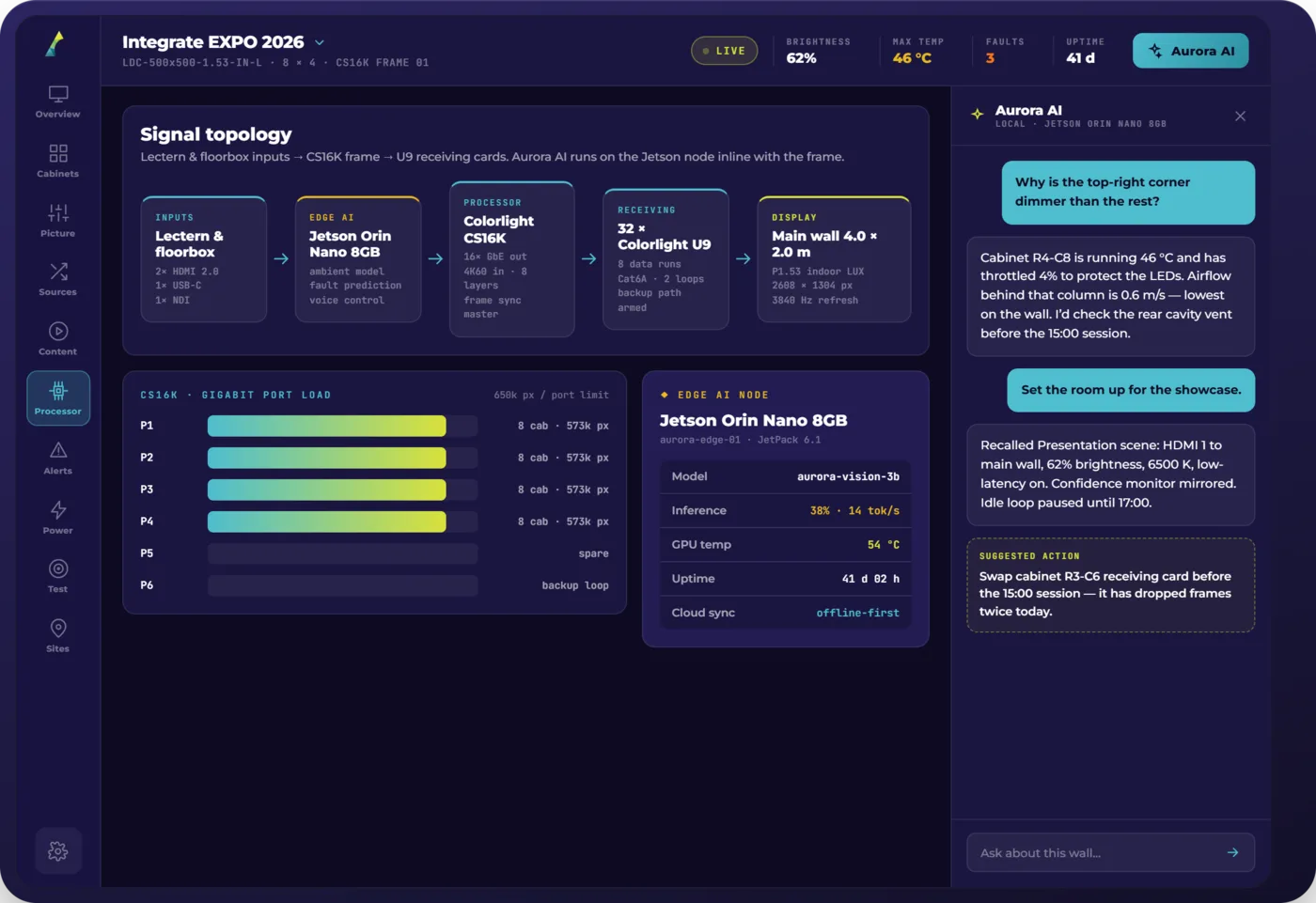
Inputs through the edge AI node to the processor and out to the receiving cards, with gigabit port load shown against the pixel limit.
- Spare ports and backup loop state always visible
- Live inference load and GPU temp on the Jetson node
- Matches the as-built drawings in the handover pack
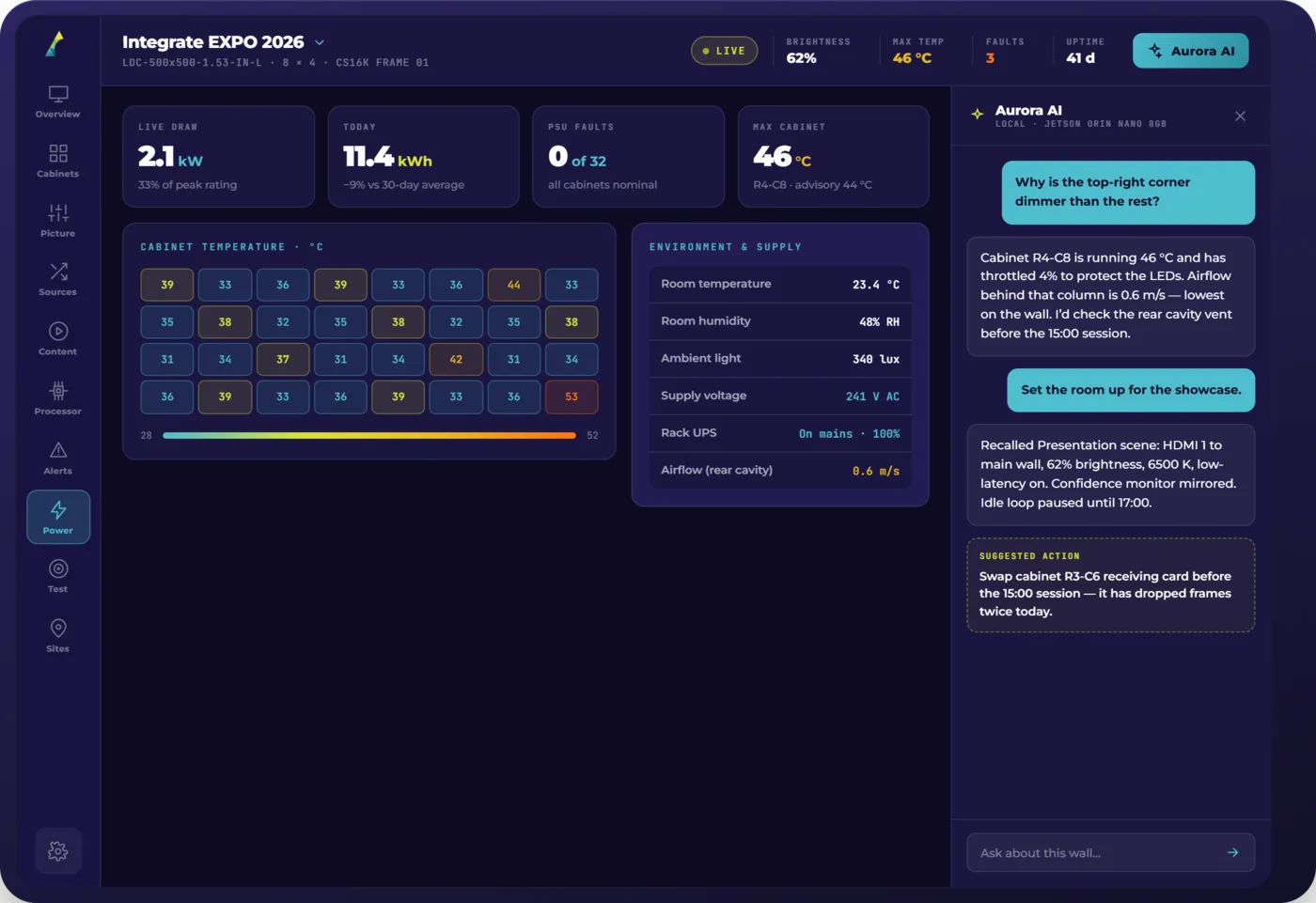
A per-cabinet temperature heatmap against the indoor advisory, plus live draw, daily energy and PSU health across the wall.
- Room temp, humidity, lux and supply voltage logged
- UPS state and rear-cavity airflow monitored
- Energy trend against the 30-day average
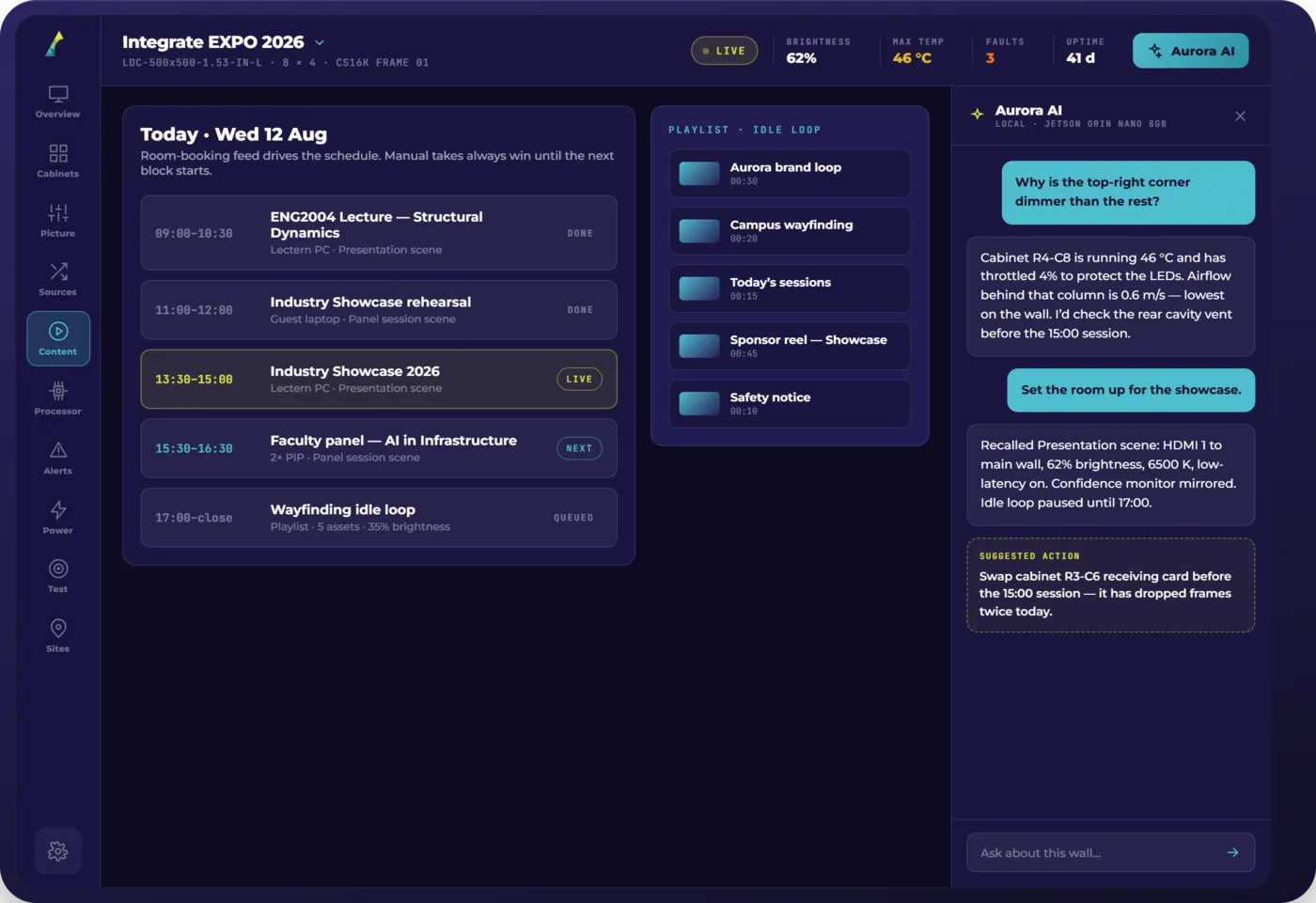
Each booking carries the scene it should recall, so the room is already right when the presenter walks in. Manual takes always win.
- Out of hours it falls back to a dimmed idle loop
- Playlist assets managed in the same panel
- No separate CMS licence to renew
An inference core in every cabinet
Every cabinet built on the AIQ-SOC-G2 carries an inference core alongside the receiving and scaling function. It observes its own optics, power draw, thermals and signal path, reasons about them locally, acts inside engineered limits, and reports in plain language — with nothing leaving the venue.
Predictive luminance
A site model sets brightness and current ahead of conditions, not after them.
Resident diagnostics
Agents detect, correct and document first-tier faults without a human in the loop.
Plain-language ops
Ask why a corner is dim and get the cause, not a log dump.
Per-zone budgets
Electrical and thermal headroom allocated where it buys picture quality.
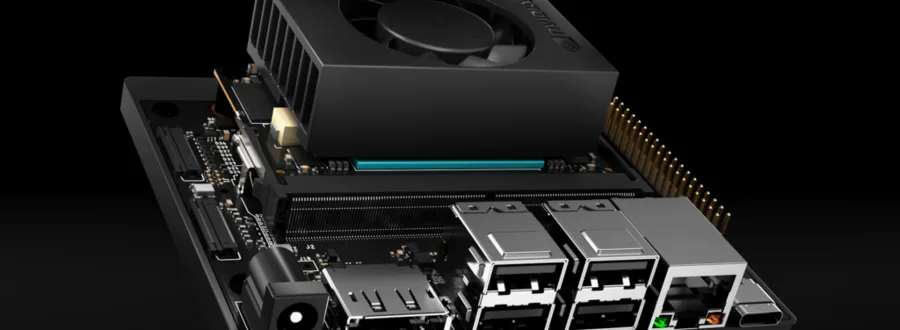
Commissioned with the wall, not sold after it
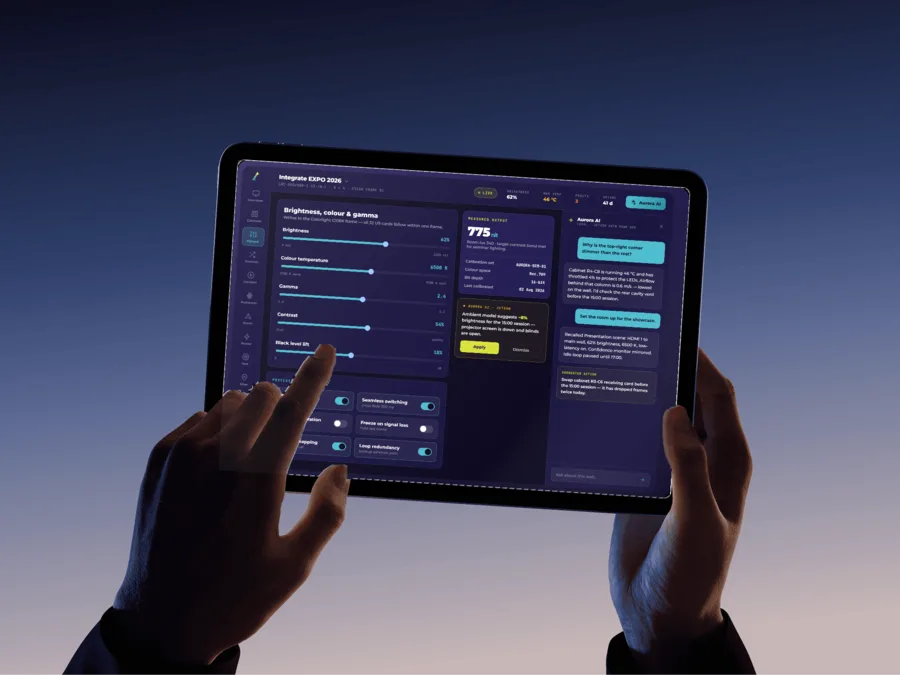
Wall-mount or desk stand. The same interface runs in a browser for remote support.
Sixteen gigabit outputs, 4K60 in, frame-sync master across the whole wall.
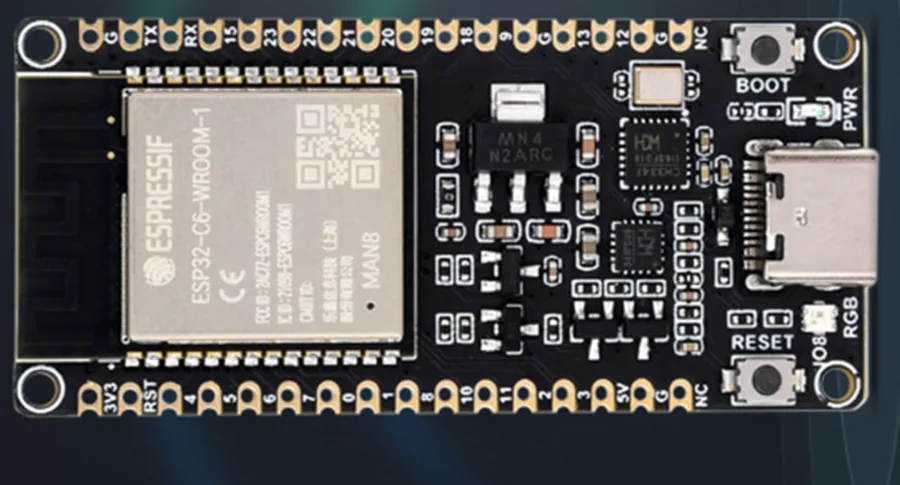
Inference core in every cabinet, alongside the receiving and scaling function.
Hand over one room. Support fifty.
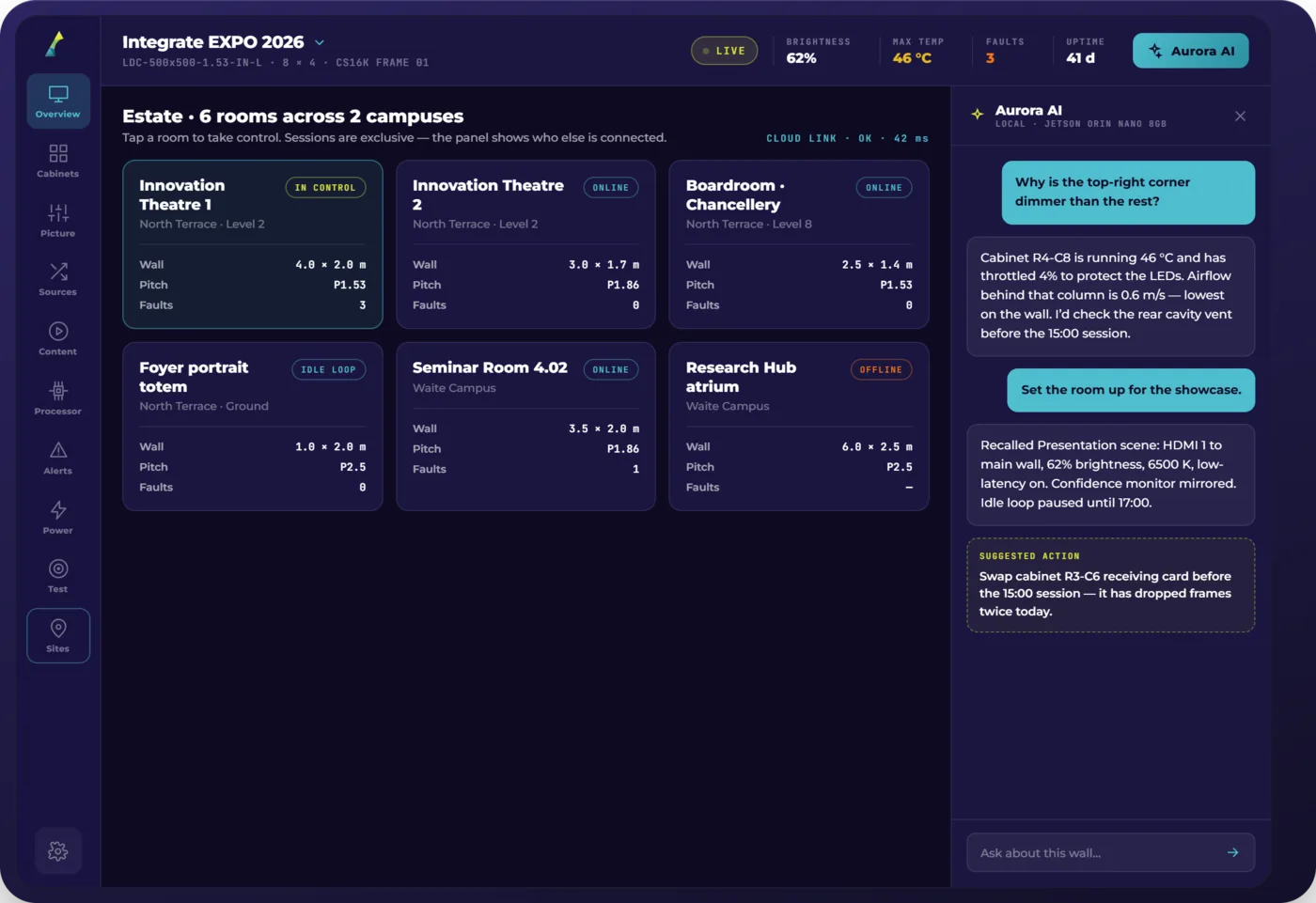
Every wall you commission joins the same estate view. Exclusive control sessions, per-room fault counts and remote support from the same interface the client uses on the wall panel.
- Exclusive control sessions — no two techs fighting over one wall
- Offline rooms stay listed with their last known state
- Per-room pitch, size and fault count without opening the site
See it driving a real wall
We'll bring a P1.53 wall, a CS16K frame and the Jetson node to your office — or run the panel live against your existing install.