COB vs SMD LED: which packaging actually wins for your install?
Chip-on-Board (COB) is being marketed as the future of fine-pitch LED. Here's where it genuinely beats Surface-Mount Device (SMD), and where the older tech still wins.
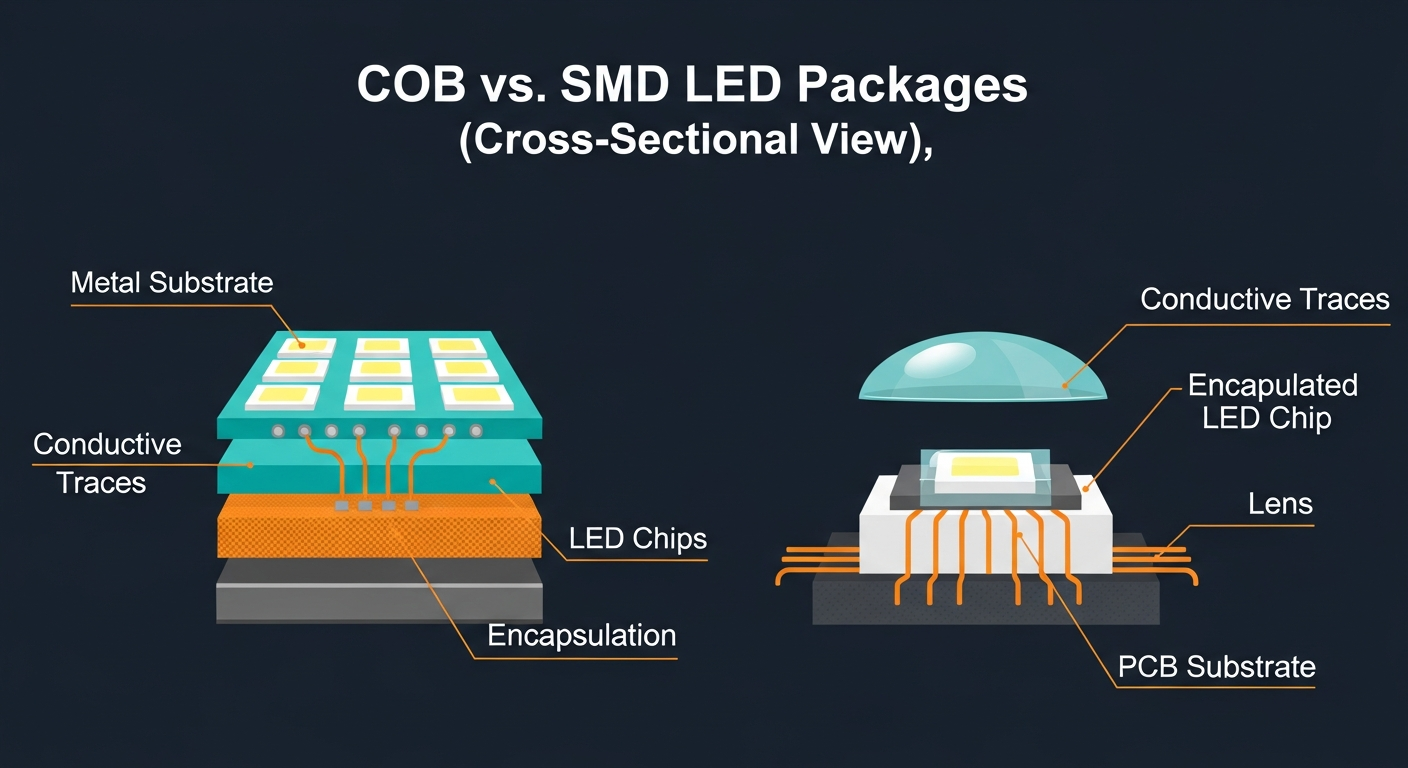
LED packaging — the way the red, green and blue dies are mounted onto the panel — quietly determines a wall’s ruggedness, its viewing angle, its peak brightness, its serviceability and its 10-year cost. For most of the last fifteen years the industry’s default has been SMD (Surface-Mount Device). In the last three years a competing technology, COB (Chip-on-Board), has moved out of high-end studio installs and into mainstream fine-pitch product lines.
The marketing argument for COB is compelling. The reality is more interesting.
How they’re built
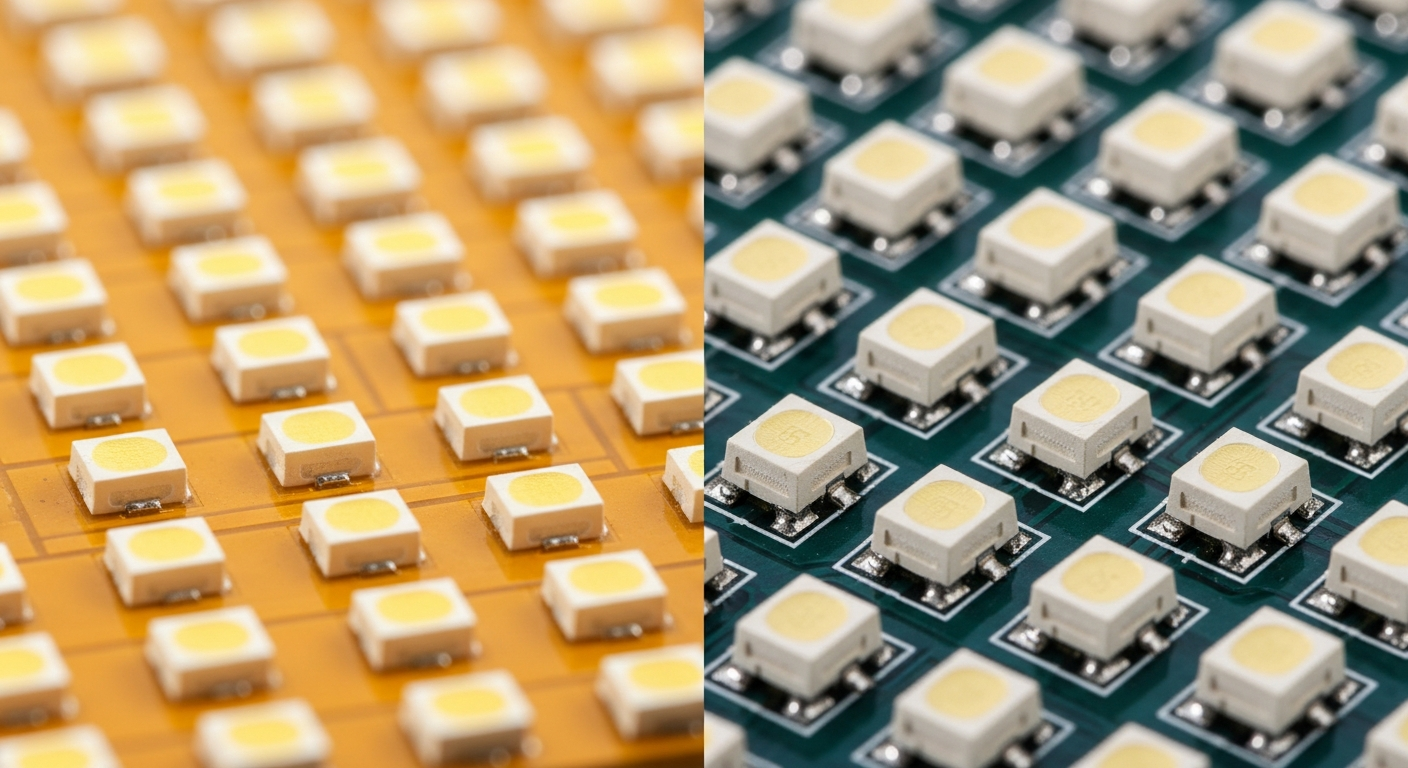
SMD packages each pixel as a tiny three-in-one component (red, green and blue dies inside a single 0.6–2.0 mm plastic carrier with a clear lens), reflow-soldered onto a PCB. It’s the same technique used to build phone motherboards, scaled down. Each pixel is a discrete, replaceable unit.
COB mounts the bare LED dies directly onto the PCB substrate and floods the whole module surface with epoxy resin. The pixels are not individually packaged — they’re protected as a continuous laminated layer.
That single difference cascades into everything else.
Where COB genuinely wins
Surface ruggedness. SMD’s clear lenses sit proud of the PCB. They can be knocked, scratched and dust-clogged. COB’s epoxy fill is flush, monolithic, and survives knocks that would dislodge an SMD lens. For touch-walls, retail-floor product displays and any surface within a metre of the public, COB removes a real failure mode.
Viewing angle and uniformity. SMD lenses act like little spotlights — even premium SMD has a brighter axial lobe and noticeable falloff at extreme angles. COB pixels emit nearly Lambertian (uniform across angle), which means a P1.5 COB wall reads cleanly from a 170° corner viewing position where SMD would look dim and colour-shifted.
Thermal performance. Heat conducts directly from the die into the PCB substrate, not through a plastic carrier. COB modules typically run 10–15 °C cooler than SMD at the same brightness, which extends LED lifespan and reduces fan duty.
Sub-millimetre pitch is easier. Below P1.0 the geometry of placing individual SMD packages becomes brutal. COB scales gracefully down to P0.4 and below.
Reflectivity and contrast. COB’s matt epoxy surface is 2–4× less reflective than SMD’s clear lenses. In high-ambient environments (lobbies, retail, broadcast studios with strong key lights) this translates to genuinely better blacks and higher perceived contrast.
Where SMD still wins
Serviceability and field economics. This is the big one. On an SMD panel, a single dead pixel is a single component you de-solder and replace. On a COB module, a single dead pixel means the whole module is replaced — the epoxy fill cannot be opened. For a 10-year asset with 50,000+ LEDs, that’s a real maintainability difference.
For a P3 outdoor wall with predictable single-pixel failures over its lifetime, SMD has a measurable repair-cost advantage. For a P0.9 studio wall where a dead pixel is a write-off either way, COB’s serviceability disadvantage is moot.
Peak brightness. SMD’s individual lenses focus light forward. The brightest production COB panels top out around 1,000 nit; the brightest production SMD panels exceed 8,000 nit. For any outdoor application or any indoor wall facing strong window light, SMD remains the only option.
Mature supply chain and cost. SMD’s scale is enormous. COB modules at the same pitch and grade are typically 30–50% more expensive at the bill-of-materials level. For mid-pitch indoor applications where COB’s premium properties don’t pay off, that cost premium is hard to justify.
Repair lead times. A failed SMD module can usually be repaired with stock components inside a week. A failed COB module typically requires a factory swap — 2–6 weeks depending on the pitch and supplier.
Decision matrix
| If your install is… | Choose |
|---|---|
| P0.9 studio or boardroom, controlled lighting, low-touch | COB |
| P1.2–P1.5 corporate lobby with high public touch | COB |
| P1.5–P2.5 retail or museum, premium look | COB if budget allows, SMD otherwise |
| P2.5–P5 indoor signage, mid-distance | SMD (cost) |
| Any outdoor application | SMD (brightness, serviceability) |
| Stadium scoreboard or perimeter | SMD (always) |
| Virtual production volume | COB (contrast, viewing angle) |
| Touch-interactive wall | COB (surface ruggedness) |
The COB binning question you must ask
The most common reason a COB wall underperforms its datasheet is not the packaging technology — it is the manufacturing process upstream of encapsulation.
In SMD production, individual RGB dies are tested and sorted (binned) by wavelength and brightness before being placed, so module-to-module colour and output consistency is built into the process. In COB, dies are placed and encapsulated in bulk. Binning at chip-level before encapsulation is labour-intensive, and most COB factories do not do it at scale.
The consequence shows up as:
- Visible colour shifts between modules and sometimes within a single module.
- Module-to-module brightness variation that pulls the weakest module’s calibration down the whole wall.
- More aggressive calibration tables that compress dynamic range.
Premium COB exists where tier-one manufacturers bin pre-encapsulation — but it carries a price premium that budget COB alternatives are not paying. The question to ask any COB supplier before signing:
“Is chip-level wavelength and brightness binning performed before encapsulation? Can you provide sample footage of a multi-module wall running at 5% and 50% brightness?”
If the answer is no, or if sample footage is not available, the COB cost saving is likely borrowing from consistency.
What we ship
Aurora’s LUX range offers both options at P0.9, P1.2 and P1.5: the LUX-COB models for high-touch and broadcast, the LUX-SMD models for traditional fine-pitch corporate. Our VSPEC and GSR ranges remain SMD across the board — at those pitches and brightness levels, COB does not pay off.
If you’re being pitched COB at every pitch from P0.9 to P5, push back. It’s not the right answer at every grade — and a supplier who pretends it is, isn’t being straight with you.
Ready to move forward?
Got a project to spec?
Send us your venue, wall size and conditions — we'll come back with a tailored configuration and budget price.