
Fine-pitch LED vs standard: when sub-millimetre pixel pitch actually pays off
Fine-pitch LED (under P1.5) is the fastest-growing segment of the market. Here's where it justifies its 2–3× cost premium and where standard pitches still win.
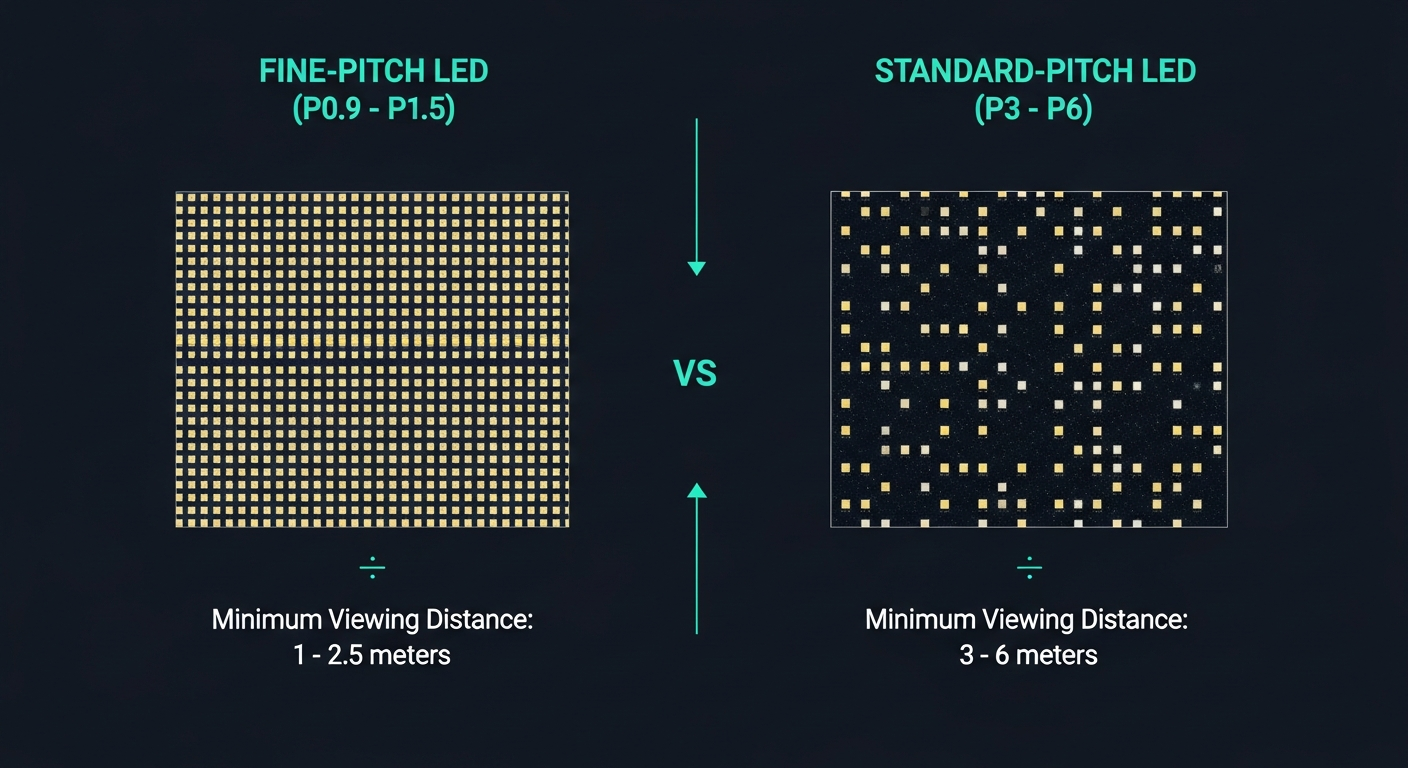
“Fine-pitch” is the LED industry’s marketing term for any indoor pixel pitch below 1.5 mm. Five years ago fine-pitch was an exotic spec for studio walls and luxury retail; today it’s offered on most LED vendors’ standard line cards down to P0.7. Buyers who’ve heard the marketing pitch — “true 4K”, “seamless” — often arrive at the project with fine-pitch already in the requirements doc, before anyone has asked whether the application needs it.
Sometimes it does. Often it doesn’t. Here’s how to tell.
What fine-pitch actually buys you
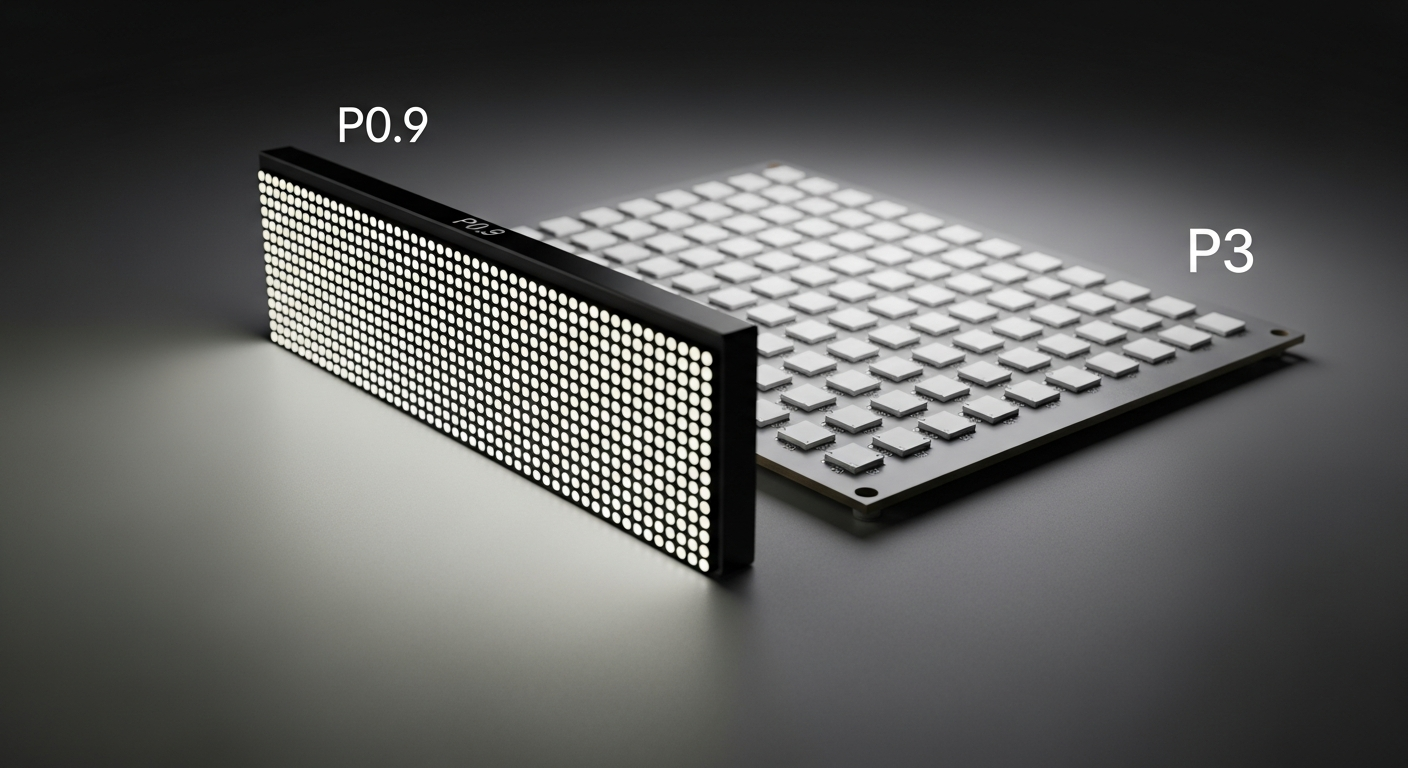
Three things, all of which are real:
- Pixels invisible at conversation distance. Below P1.5 the eye cannot resolve individual dots beyond about 75 cm. The wall reads as image, not as grid.
- Camera-friendly resolution. A 4K camera sensor outresolves any wall coarser than P0.9 at typical studio framing distances. Fine-pitch is the only choice for in-camera virtual production.
- Integration with regular AV at native UHD. A 4 m × 2.25 m P1.5 wall is exactly 2,667 × 1,500 pixels — close enough to UHD that source content can be authored once and shown without scaling artefacts.
What it costs
Fine-pitch is roughly 2–3× the per-m² price of a comparable VSPEC-grade P3 wall. The cost driver is LED count: a P1.5 panel has four times the LEDs of a P3 panel of the same area.
| Pitch | Indicative cost per m² | LED count per m² |
|---|---|---|
| P0.9 | $7,500–10,000 | 1.23 M |
| P1.5 | $4,500–6,000 | 444 k |
| P2.5 | $2,500–3,500 | 160 k |
| P3 | $1,800–2,500 | 111 k |
| P5 | $1,400–2,000 | 40 k |
Power, thermal, structural and processor specifications all rise with LED count too — a P0.9 wall is not just 4× the LEDs of a P1.5 wall, it’s also ~1.6× the wattage and ~1.5× the structural dead-weight.
When fine-pitch genuinely pays off
Boardroom and executive control room. Viewers seated 2–3 m from a 4 m wall are inside the resolving distance of P1.5–P2. Sub-millimetre pitch (P0.9) only pays off if the room hosts broadcast cameras or you regularly review fine-grained engineering content (PCB layouts, GIS, broadcast frame-by-frame).
Premium retail vitrine. Shoppers stand at 0.5–1.5 m. P1.5 is the sweet spot for a near-touch experience without paying for resolution they can’t see.
Studio virtual production. Camera trumps eye. P1.5 to P0.9 is mandatory.
Museum / experiential. Same reasoning as retail vitrine. Patron dwell distance is short.
When standard pitch wins
Lobby and atrium walls. Patrons walk through; closest dwell is typically 3–4 m. P2.5 satisfies the 50× rule for that distance and saves 40–60% on capital and lifetime cost.
Restaurant / hospitality. Diners sit 3–5 m back. P3 reads as cinema-quality image.
Stadium scoreboards and ribbons. Viewers are 30–120 m back. Anything finer than P5 is wasted money. See our buying guide for the full distance table.
Corporate signage in corridors. The 50× rule says P2.5 reads cleanly from 1.3 m and beyond. P1.5 here is a vanity spec.
The “future-proofing” trap
A common argument for fine-pitch where the application doesn’t need it: “audience expectations of resolution will rise; let’s spec one step finer to last 10 years.”
Three problems:
- The wall doesn’t get sharper to the eye over 10 years; the eye doesn’t get better. The 50× rule is biology, not technology.
- The cost of “one step finer” is 50–100% more capital, plus higher lifetime power and processor cost.
- If audience expectations do rise, what changes is content quality and pixel density on phones — not the perceived sharpness of a wall they look at from across the room.
If you genuinely think your wall might be re-purposed to a much closer viewing distance later (e.g. lobby wall today, immersive selfie wall in 3 years), specify a removable front row of finer-pitch panels for that section, not the whole wall.
Fine-pitch maintenance reality
A P0.9 wall has 1.23 million LEDs per square metre. Even at 99.999% LED reliability, you can expect 12–15 dead pixels per m² over 10 years. Fine-pitch maintenance plans need to budget for this — and the field-replacement workflow has to be slick.
Aurora’s LUX range ships with magnetic front-service modules below P1.5 — any single module pops out from the front in under 30 seconds, no tools, no rear access required. Cheaper fine-pitch vendors require rear-service or full panel-pull, which is unworkable on a wall mounted hard against a building structure.
Bottom line
Fine-pitch is right when the audience is genuinely close, when broadcast cameras are in the shot, or when the wall is the centrepiece of a premium experience. For everything else — corporate signage, hospitality, lobbies, stadiums — standard-pitch cabinets deliver equivalent perceived quality at a fraction of the cost. Pick the right pitch for the actual viewing distance and you’ll be happier on day one and cheaper on day 3,650.
Browse the LUX fine-pitch range or model your wall in ScreenBuilder to see the cost difference between pitches in your specific configuration.
Ready to move forward?
Got a project to spec?
Send us your venue, wall size and conditions — we'll come back with a tailored configuration and budget price.