LED Billboard Lifespan Australia — What to Expect Over 7–15 Years
Outdoor LED billboards in Australia are rated at 50,000–100,000 hours — 7–15 years at 18 h/day. The real commercial-life driver is driver IC and PSU replacement at years 5–7, not LED die failure.
A quality outdoor LED billboard is rated at 50,000–100,000 hours of LED life — roughly 7 to 15 years running 18 hours a day — based on the manufacturer's L70 brightness-decay rating. In practice, the commercial lifespan is set earlier, by driver IC and power-supply degradation rather than LED die failure, with the first planned driver/PSU replacement typically falling between years 5 and 7. Aurora's GSR-range outdoor billboards ship with a maintenance programme built around that replacement window, backed by AU-local spares stock in Adelaide, Sydney and Brisbane, so a well-maintained installation reliably reaches 10+ years of commercial operation.
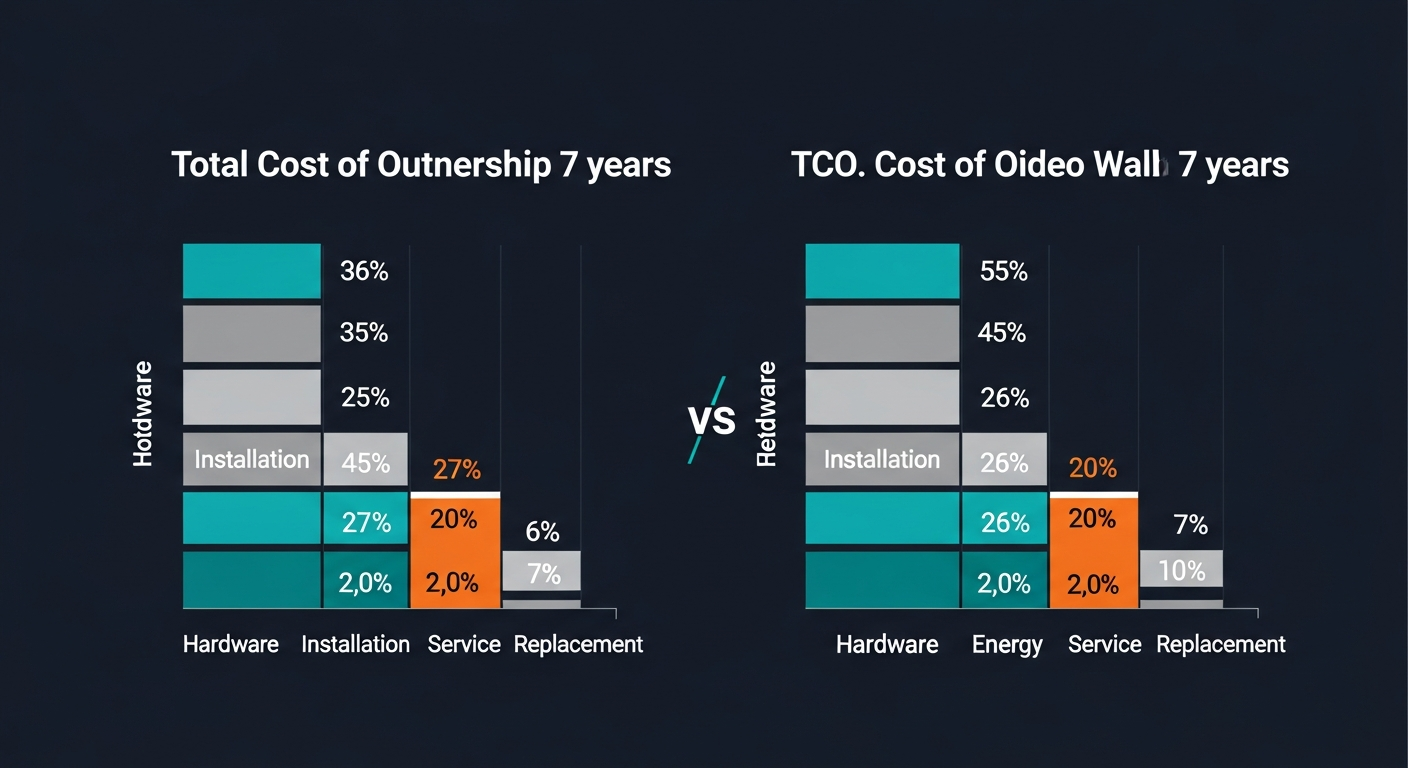
A quality outdoor LED billboard is rated at 50,000–100,000 hours — 7 to 15 years at 18 hours per day. In practice, the commercial life is set not by LED die failure but by driver IC and power supply degradation, which typically surfaces between years 5 and 7 — the real commercial replacement trigger, not the LED die spec.
How the LED lifespan spec is calculated
The 50,000–100,000 hour figure comes from manufacturer L70 ratings — the point at which average brightness across the display falls to 70% of its as-installed level. L70 is the industry standard for LED lighting and display components, and it is what reputable suppliers publish.
For an outdoor billboard running 18 hours per day:
| L70 rating | Years to L70 at 18 h/day |
|---|---|
| 50,000 h | ~7.6 years |
| 70,000 h | ~10.7 years |
| 100,000 h | ~15.2 years |
The spec is meaningful but it describes LED die behaviour in isolation. The cabinet is a system — driver ICs, power supplies, printed circuit boards, enclosure seals and connectors all age on their own curves. The practical life of an outdoor billboard in Australian conditions is set by whichever component degrades first.
The real life-limiter: driver ICs and power supplies
LED drivers are the integrated circuits that convert the digital signal from the receiving card into the precise current waveform that drives each LED pixel. They operate at elevated temperatures inside sealed cabinets, and they degrade through a combination of:
- Thermal cycling — Australian outdoor cabinets experience 30–50°C ambient temperature swings daily. Each cycle slightly fatigues bond wires and solder joints.
- Sustained high temperature — dark-coloured rear panels in full-sun north Australian installations can reach 70°C internal ambient. Driver ICs are rated to operate to 85–105°C, but sustained operation at the top of that range accelerates electromigration.
- Voltage stress — driver ICs on cheaper cabinets operate close to their absolute maximum ratings, leaving no margin for supply voltage fluctuations from the grid.
The failure signature is not sudden — it is gradual. Columns of pixels develop brightness inconsistency, then specific subpixels dropout, then whole driver domains fail. By the time it is visible to a passer-by, multiple driver ICs are already degraded.
Power supply units (PSUs) follow a similar curve. Electrolytic capacitors inside the PSU dry out through heat exposure. Plan for at least one PSU per cabinet across the fleet between years 5 and 8. A quality outdoor billboard cabinet uses a PSU rated at 150–200% of its typical operating load, which extends capacitor life significantly. Budget-grade PSUs run at 90–95% load continuously and degrade in 3–5 years in AU conditions.
Year-by-year degradation model
A representative outdoor billboard in metro Australia, running 18 h/day at moderate brightness (3,000–5,000 nit):
| Year | Expected condition | Recommended action |
|---|---|---|
| 0–2 | Uniform, at spec brightness | Annual inspection |
| 2–4 | Minor brightness drift (<5%); individual LED dropouts at <0.1% | Re-calibrate (Year 3); continue routine service |
| 4–6 | Brightness at 80–90% of as-installed; first driver IC failures; PSU inspection due | Re-calibrate; replace failed driver domains; PSU audit |
| 5–7 | Driver IC replacement window — the practical break-even point between repair and partial refresh | Planned driver IC + PSU replacement programme |
| 7–10 | Post-replacement unit at near-original brightness; LED die approaching L70 | Continue routine service; plan for next-generation refresh |
| 10–12 | LED brightness at or below L70 threshold; significant recalibration no longer effective | Full cabinet replacement or redevelopment |
The 5–7 year driver replacement is not a failure event — it is a planned maintenance milestone, comparable to a vehicle engine rebuild. A quality-grade outdoor cabinet from a manufacturer who keeps AU-local spares can be refreshed at this point for roughly 20–30% of the original hardware cost.
What shortens billboard life in Australian conditions
Several factors specific to AU deployments accelerate degradation beyond the global averages:
Solar irradiance. Australia has among the highest solar irradiance levels of any developed country. Full-sun cabinet temperatures in QLD, WA and SA push internal temperatures 10–15°C above European or East Asian baseline assumptions. Spec the thermal management and choose a cabinet with fan-assisted rear ventilation or a heat-sink chassis design for these locations.
Coastal salt aerosol. Sodium chloride aerosol penetrates microscopic gaps in conformal coating and corrodes exposed copper traces and solder joints on PCBs. Even an IP65-rated cabinet with sealed entry points can accumulate trace ingress over years if gaskets are not maintained. For coastal sites, conformal-coated electronics and marine-grade fasteners are the correct specification — not optional. See outdoor LED billboard IP rating requirements for the full treatment of coastal IP considerations.
Voltage sag on rural circuits. Regional and remote Australian sites are often supplied by long distribution runs with significant voltage sag under load. PSUs outside their specified voltage tolerance run hotter and degrade faster. Specify a wide-input-range PSU (typically 100–305 V AC) and consider a voltage conditioner for any rural install more than 2 km from a substation.
Monsoon-season thermal shock. Darwin, Broome and Cairns see intense solar heating followed by rapid temperature drops in late-afternoon storm cells. The rate of thermal change — not just the absolute temperature — determines gasket and solder fatigue rate. This is why far-north deployments warrant IP66 minimum regardless of proximity to the coast.
Maintenance schedule that protects your investment
An outdoor LED billboard in Australia operated to manufacturer spec and maintained on this schedule will reliably achieve 10+ years of commercial operation:
- Annual: Visual inspection, front-face cleaning, brightness measurement with a calibrated light meter, gasket integrity check, PSU voltage and temperature log.
- Year 3: Full recalibration of all modules for brightness and colour uniformity.
- Year 5–7: Driver IC and PSU audit; proactive replacement of degraded units before visible failure.
- Year 7: Second full recalibration; structural fastener inspection and replacement as required.
- Year 10: Condition assessment for cabinet refresh vs full replacement decision.
Aurora’s service programme for GSR-range outdoor billboards includes this schedule as standard, with AU-local spares stock held in Adelaide, Sydney and Brisbane for next-day dispatch.
Total cost over the billboard’s life
The maintenance schedule above adds cost that is not in the original capital quote. For the full 10-year operating model — power, calibration, spares, service — use the cost of ownership calculator.
For AU-specific capital cost figures (cabinet, installation, council approvals), see LED billboard cost in Australia.
For a site-specific assessment of expected lifespan and the recommended maintenance programme for your location and operating hours, contact the Aurora team or request a quote.
Ready to move forward?
Got a project to spec?
Send us your venue, wall size and conditions — we'll come back with a tailored configuration and budget price.