Total cost of ownership for LED video walls: the 10-year picture
The capital quote on an LED wall is only the first 50–60% of what you'll spend over its life. Here's the full 10-year cost picture and how to plan for it.
When a buyer asks for an LED wall quote, what they receive is a cabinet line, a controller line, a frame line, an install line and a freight line. That number — the capital quote — is what gets compared between vendors and what gets approved on the procurement page.
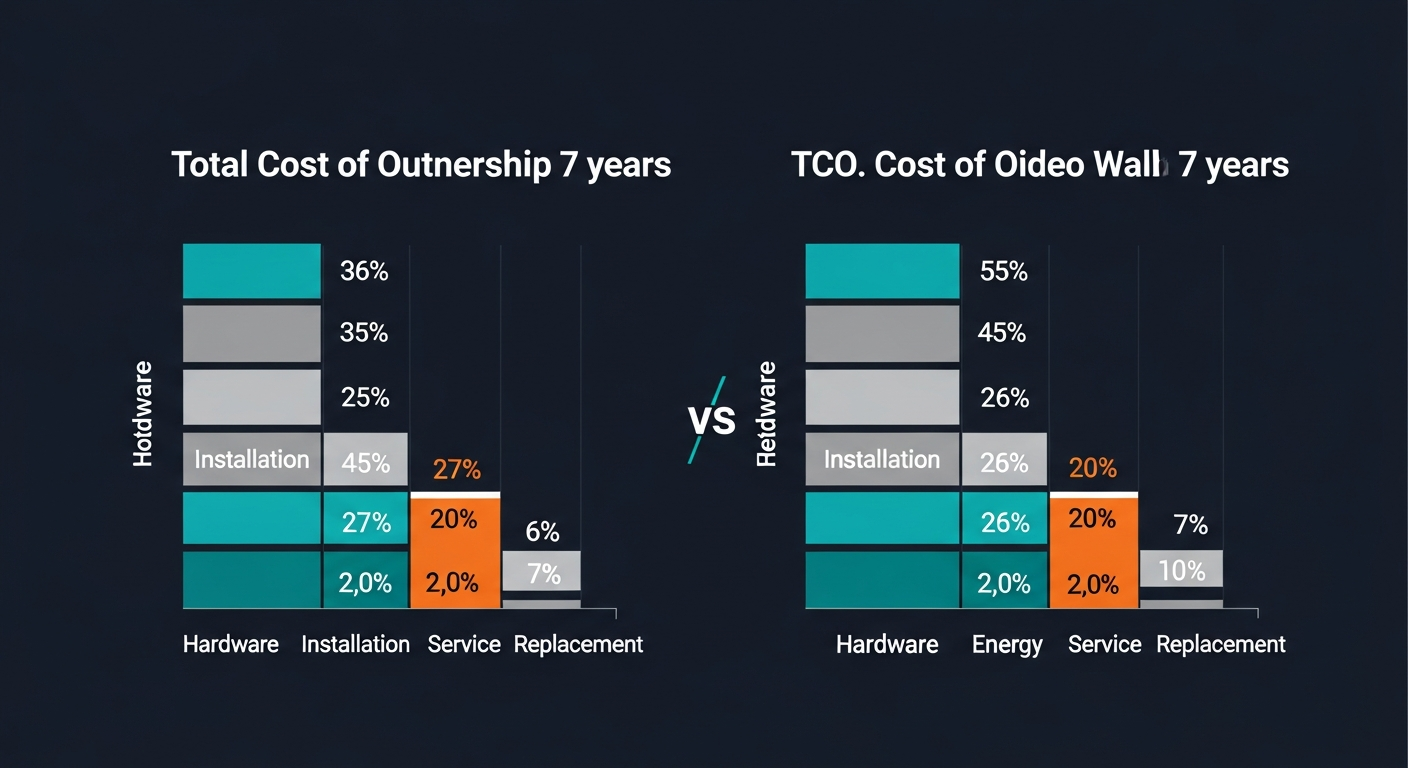
It is also, on a 10-year asset, only 50–60% of what the wall will actually cost.
The other 40–50% is power, processor licensing renewals, calibration, spares, content delivery and end-of-life. Vendors who win on the capital quote sometimes do so by transferring cost into those buckets and away from the page you’re looking at.
Here is what a 10-year TCO actually looks like, and how to plan for it.
The five non-CapEx cost lines
1. Power
A 20 m² indoor P2.5 wall at standard operating brightness (400 nit) draws roughly 4–5 kW continuous. At Australian commercial rates (~28 c/kWh) and 12 hours/day operation, that’s $5,000–6,500/year — about $55,000 over 10 years.
Outdoor walls are worse. A 30 m² P10 outdoor scoreboard running peak-bright daytime and dimmed overnight averages 6–8 kW; at 24/7 it’s $14,000–20,000/year, or up to $200,000 over the asset life.
Cabinet-level efficiency varies by 20–30% between premium and budget brands. The premium cabinet can pay back its capital premium in power savings alone over 5–7 years.
2. Processor and software licensing
The processor (Novastar, Brompton, Colorlight or similar) is usually a one-off purchase — but firmware updates, licensed colour-management modules and HDR feature packs ship as paid annual subscriptions on premium controllers. Budget for $1,500–4,000/year on a Brompton stack, $0 on a basic Novastar workflow if you accept the feature freeze.
Some vendors include processor licensing in their first-year quote and renew it at full retail in year two. Read the renewal terms.
3. Calibration
Brightness and colour drift are physics, not vendor failure. LED brightness falls roughly 5–10% in the first 1,000 hours and continues to drift slowly after. Without periodic re-calibration, what was a uniform wall at install becomes a patchwork by year 3.
Plan for full wall re-calibration at year 1, year 4 and year 7. Cost: $3,000–8,000 per visit depending on wall size and access.
4. Spares and field service
Even premium walls lose a tiny percentage of LEDs over time. Plan for:
- 0.5–1% module replacement over 10 years on indoor walls.
- 1–2% on outdoor walls (UV and thermal cycling).
- 1 power supply per cabinet typically dies between years 5 and 8.
Carry on-site spares of 2% of total module count, 1 spare PSU per 10 cabinets, and 1 spare receiving card per 20 cabinets. For a 60-cabinet indoor wall that’s roughly $8,000–12,000 in spares stock and $4,000–8,000/year in service-call labour.
If your supplier doesn’t keep AU-local spares stock, plan for a 4–8 week air-freight wait every time something fails.
5. Content delivery, AV plumbing and end-of-life
Easy to forget, real money. Source-side AV equipment (media players, scalers, KVMs), content management subscriptions, network connectivity and the eventual decommission/recycle cost should all be in the model. Together they’re typically 5–10% of CapEx amortised across the life.
A worked 10-year TCO
A representative 30 m² indoor P2.5 lobby wall, premium grade:
| Line | Cost |
|---|---|
| Capital (cabinets, controller, frame, install) | $180,000 |
| Power (12 h/day × 10 y) | $58,000 |
| Processor licensing (premium stack) | $22,000 |
| Calibration (3 visits) | $14,000 |
| Spares stock + field service (10 y) | $42,000 |
| Content/AV/end-of-life | $14,000 |
| 10-year total | $330,000 |
The CapEx figure is 55% of the total. A “$30,000 cheaper” budget cabinet that costs an extra $1,500/year in power and $2,000/year in spares costs $5,000 more over 10 years, not less.
ScreenBuilder-verified: a real COB fine-pitch install, 10-year TCO
The table below is drawn from an actual ScreenBuilder running-costs report dated 15 May 2026 — not an estimate. Module: LDC60012SFP-COB-PLUS-L (1.2 mm COB fine-pitch). Wall: 6.60 m × 6.75 m, 220 cabinets (44.55 m²).
| Line | Annual | 10-year total | % of TCO |
|---|---|---|---|
| Capex amortisation (7-year) | A$11,833 | A$82,831 (yrs 1–7) | 60% |
| Energy (19,947 kWh/yr @ AU tariff) | A$6,383 | A$63,830 | 32% |
| Maintenance | A$1,114 | A$11,140 | 6% |
| Module replacement reserve | A$345 | A$3,450 | 2% |
| Total (years 1–7) | A$19,675 / yr | ||
| Total (years 8–10, capex fully amortised) | A$7,842 / yr | ||
| 10-year lifetime total | A$161,255 |
Real-time power draw at operating brightness: 4.55 kW. Cost per operational hour: A$4.49.
The capex amortisation line (60%) disappears after year 7 — illustrating why running a quality LED wall to years 8–10 dramatically lowers its effective cost-per-hour vs replacing it at year 5.
How to compare vendors honestly
Three rules:
-
Get power consumption in writing. Both peak (sun-exposed scenarios for outdoor) and typical-operating (your actual scheduled brightness profile). Multiply by your hours and your power rate. The difference between vendors is usually visible in a single afternoon’s spreadsheet work.
-
Get the processor renewal terms in writing. Year 1 vs years 2–10. If the vendor cannot tell you what year-3 licensing costs, assume the worst and price it in.
-
Get the spares lead time in writing. “We carry stock in Australia” should be evidenced by a parts list and a state-by-state location.
Use the calculator
We built a free interactive calculator that lets you model the full 5-, 7- and 10-year cost of any wall configuration — power rates, brightness profile, processor stack and spares-pool decisions all configurable. No sign-up.
Open the cost-of-ownership calculator →
If you’d rather have us walk through the model with your actual quote, send it across and we’ll come back with an apples-to-apples comparison against the equivalent Aurora configuration.
Ready to move forward?
Got a project to spec?
Send us your venue, wall size and conditions — we'll come back with a tailored configuration and budget price.